
Menu
Adarsh PU College. Best PU College in South Bangalore

A JAIN INSTITUTION
SITADEVI RATANCHAND NAHAR
ADARSH PU COLLEGE
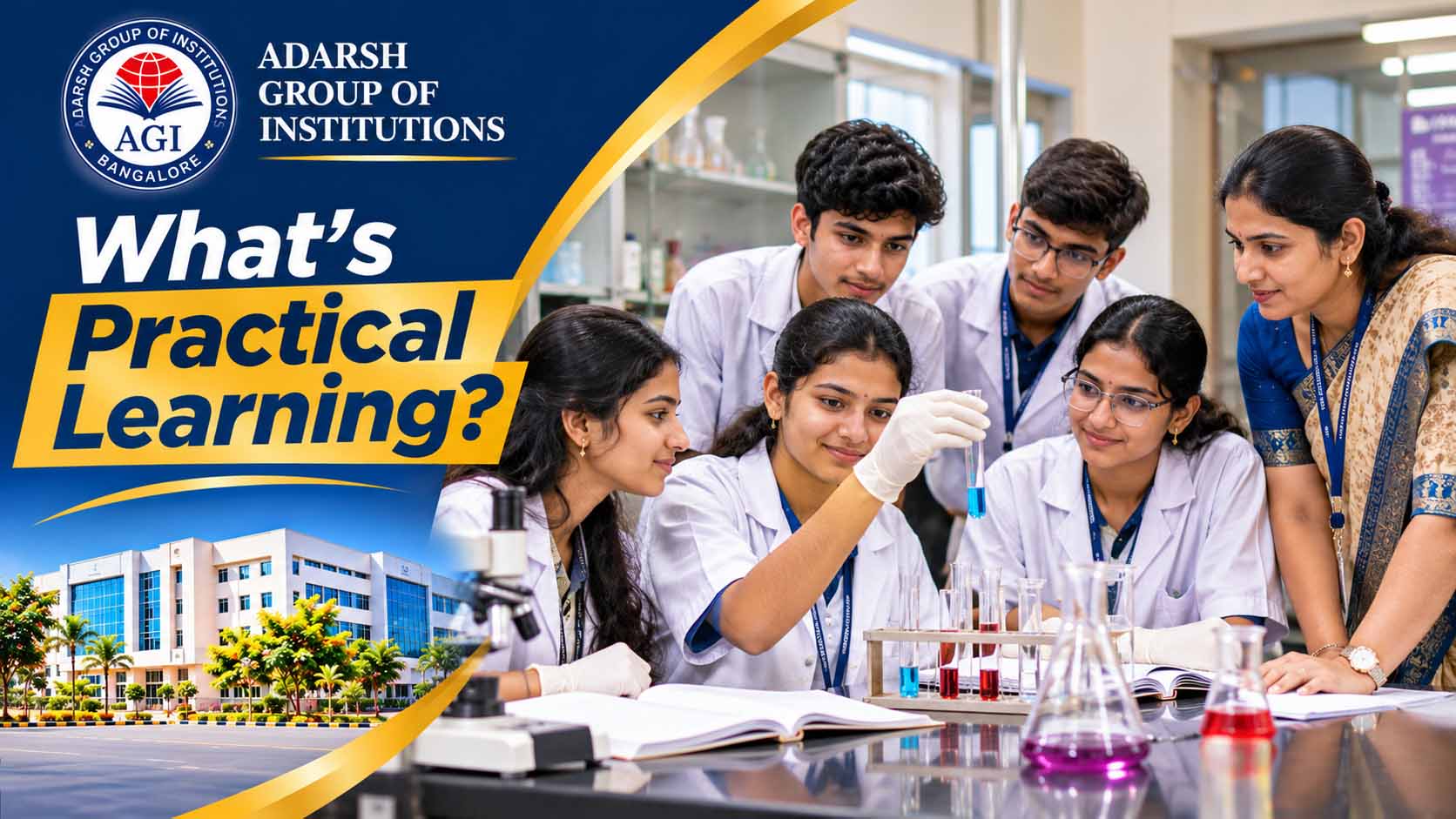
Practical learning is an approach to education where students gain knowledge and understanding through hands-on activities, experiments, demonstrations, projects and real-life experiences. Instead of depending only on textbooks and classroom explanations, students get opportunities to apply what they learn in practical situations.
For PU students, practical learning plays an important role in making academic subjects easier to understand. It connects theoretical concepts with real-world applications and encourages students to become active participants in their education.
Practical learning, often described as learning by doing, allows students to explore concepts through activities and experiences. For example, students studying science can perform laboratory experiments to understand scientific principles. Similarly, students learning computer science can practise programming and develop simple applications.
These activities help students understand not only what they are learning but also how the knowledge can be used outside the classroom.
Textbook knowledge provides the foundation for understanding a subject. However, practical activities help students see how those concepts work in real situations.
Science experiments, mathematical activities, computer projects and classroom demonstrations give students opportunities to apply their knowledge. This connection makes learning more meaningful and helps students remember concepts more effectively.
Practical learning encourages students to think independently and find solutions to challenges. During experiments and projects, students may encounter unexpected results or difficulties.
By observing, analysing and trying different approaches, they learn to identify problems and work towards solutions. These experiences help develop logical thinking and decision-making abilities.
Students often become more confident when they actively participate in learning activities. Group projects, presentations, experiments and demonstrations encourage them to share ideas and communicate with others.
Such experiences also help students overcome hesitation and become more comfortable expressing their understanding in front of classmates and teachers.
Practical activities give students the freedom to explore ideas and ask questions. They can experiment with different methods, test their understanding and discover new ways of approaching a topic.
This process encourages curiosity and creativity. It also helps students develop an interest in subjects by making lessons more interactive and engaging.
Practical learning introduces students to skills that are useful beyond their immediate academic requirements. Research, observation, communication, teamwork and time management can all develop through hands-on activities.
These abilities can support students as they move into degree programmes, professional courses and future career opportunities.
Teachers play an important role in making practical learning effective. They can support students through demonstrations, laboratory sessions, discussions, assignments and project-based activities.
By connecting classroom lessons with practical examples, teachers help students understand difficult concepts and encourage them to participate actively in the learning process.
Practical learning makes education more meaningful by helping students connect theoretical knowledge with real-life experiences. It encourages curiosity, improves understanding and develops problem-solving, communication and teamwork skills.
For PU students, combining classroom learning with practical activities can create a stronger academic foundation and prepare them for the learning opportunities and challenges ahead.
Students planning their Pre-University education should compare available science combinations, academic support and learning opportunities before selecting a college.
Visit the SRN Adarsh PU College website to explore the available programmes and enquire about current admission requirements.
Effective revision strategies help PU science students organise their preparation, strengthen subject knowledge and identify areas for improvement. By following a realistic timetable, practising questions and maintaining healthy study habits, students can approach their board examinations with greater confidence.